A Mediterranean History

Ben, his voice emerging from his beatbox belt,

assures his comet tail of visitors that opulent

extravagance will always give simple piety

a run for its money. New age apostle, he’s

Speaking of the baroque, a style that clothes his city. –

Valetta, much photographed, much toured,

much bombed. Its spine, Republic Street [commemorates

Independence from us Brits] runs arrow straight

down to Saint Elmo’s Fort, now a war shrine

to survival. We cross it several times – past palaces,

churches, bars, museums, high windows where

still the ravages of war are yet to be repaired.


I leave Ben at the Co-cathedral of Saint John.

Who can fail to marvel at the transformation

Stone displays when every inch has been the subject

of a golden alchemy? It is religion’s trinket box.

And who cannot wonder at the wealth and power

of those who chose to stop our doubting mouths

with gold.  They also have another asset – Caravaggio,

who comes here to escape Roman justice

as a murderer – and faces death himself.

The Knights of Malta do not miss a trick.

He’s promoted, then protected by his rank.

They give him a wall of their cathedral to fill,

and the sentence of their martyred saint as theme.


Caravaggio invents a line of beauty sharp

with miracles, his oils flame in the darkness,

are sunlight following – it’s invisible presence

placed with unerring stagecraft to discover

humanity clothed in its bloody everyday.

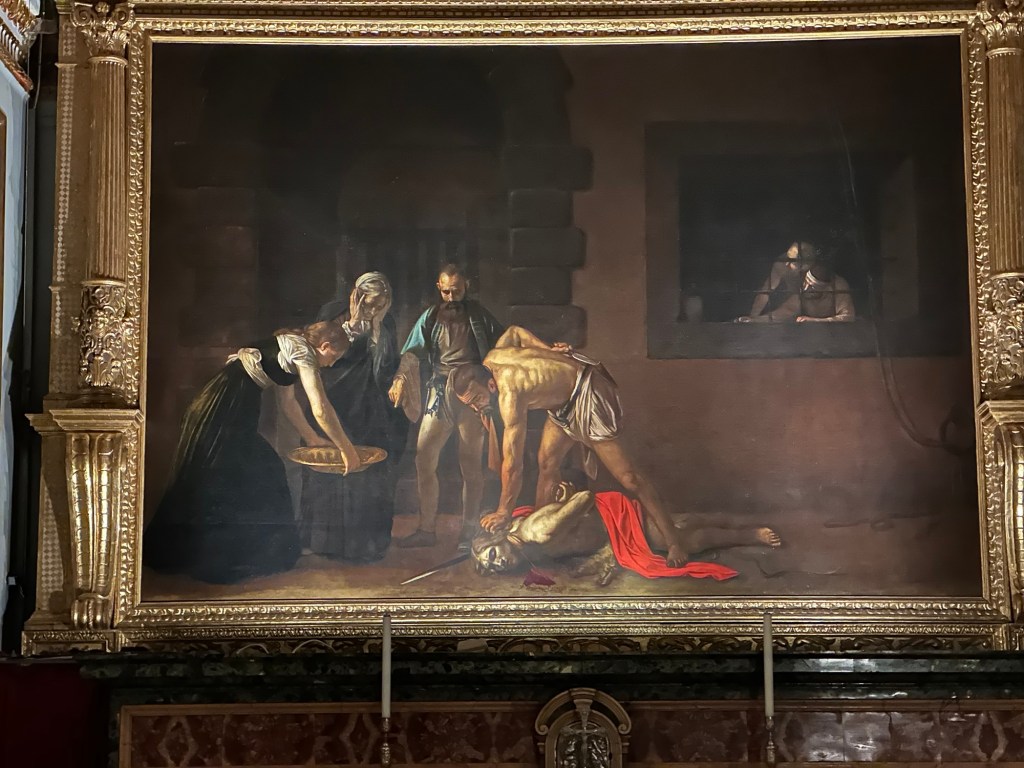
There is the Baptist, whose pale and nearly  

severed head now cannot see the point at all.

Behind, the muscled, semi-naked executioner

gleams like a freshly risen Christ. One hand

grasps hair, the other holds a butcher’s knife

concealed behind his back. And there’s Salome,

ordinary girl in a peasant skirt, and cause of all,

whose petulant revenge holds out a salver

for the hacked-off head. Then the witnesses –

the determined jailer, bearded, stern, points a

finger of command; a woman old and shocked,

maybe the baptist’s mother summoned for

the punishment of grief; and two prisoners

seeing their own inevitable end. Tiny at the bottom,

only just untainted by the blood, the signature,

the only one he left in paint, of Michelangelo

de Caravaggio, He too destined for an early death,

not from an executioner but from disease or drains.


Brilliant and engaging, but remember, beyond

the expected sudden shock of drama, the epic

reimagined story, and the meretricious opulence

of the church which frames all this, there is the feel

of pointlessness. A greatness that has outlived,

is just the price of leaf, the value of the auction house.


Somewhere on Ben’s two-hour tour, he will have

reached the bar where Oliver Reed performed

his final moments, his body washed and cleansed

with lager, scotch and emptied thought. I try to

picture this death scene as Caravaggio might

have rendered it – The sunlight playing on

vacated glasses; the eyes just losing

sight and focus; the other drinkers open-

mouthed but ready to remember the roles they

played. This place another shrine where

legends grow to miracles, to capture laughing.

SeaBreeze – Fish and Shell

In the fish restaurant, all is calm – the Southern

Ocean has given up its harvest. We are dining

on names that once swam in explorers Journals,

now acting out the role of fish and chips or dover sole..

The staff are uproariously attentive. We are flattered

with their jokes, overwhelmed with happiness to be

our friends and guides. Of course, they all are black.

We, and all the other customers, are white.

And this is multi-racial Western Cape,

where Dutch settlers stole the land from Khoikhoi folk,

who got there first. They likely had no concept that land

could be owned, like wives or cattle, and was not there

for every living thing,  man or beast. Now, post-Mandela,

the Cape pretends to harmony and doesn’t notice

Irony. White culture seeks to sell itself as everybody’s

friend -and old relationships Persist in subtler forms

and, true, the food is good, the wine accommodating.

The sacrifice of fish has cast aside the darkness,

emboldened us to walk the streets and feel no fear.


Bulawayo Bound

On the track to Bulawayo , arrow straight for a century

of miles, a water tank, empty and abandoned, waits

for a Northern 4-8-4 that never comes.

It is years since the tank held water, or rails sang

with approaching locomotives, up from the Cape.

This was Rhodes’ steel road, hoping for the distant bazaars of

Cairo and the Med. A dream alone. It never

forged its link through pink protectorates and colonies.

Rhodes died. and the vision ran out like water

 in the desert, somewhere north of Victoria Falls,

the smoke that thunders. Today there is no rush

of steam choking at a train’s open windows.

Africa is overflown, the colonial project discredited.

Telegraph poles stand empty , their thirteen lines

long gone, the messages of trade and order lost.


Our train’s restored and regal, at strolling speed

evokes a land of almost, never was.

We toast the day’s horizons, the baobab trees,

The dry Savannahs with their curious giraffes.

Half a mile ahead the line curves – we glimpse

the Chinese diesels, fancy we can hear their distant

growl as carriage wheels they click and scream.


At home from school time in the simple townships

children dressed in smart black uniforms

with bright school bags, wave and laugh after

this weekly phantasm which leaves them all behind.

Beyond, The human world slips into myths,

tears up its promises, and overlooked the lion sleeps,

impala step on dainty feet, and wait,

 a startled hippo shows an angry mouth.


AFTER THE FUNERAL

Formalities over and farewells exchanged,

and a short ride through the town to the station –

May sunshine arouses the smell of departure

and carriages, warms the platform crowded with children.

They’re blazered and tied, and on their way home,

with voices sounding of suburbs and London –

confident in football and matches, their faces laughing,

and eager. Black children from freed generations,

and lost times of service on plantations,

and post war devotion to Queen and to promises.


The train comes and carries them homewards

and station on station deposits them places

where new lives have rooted, chains cast aside

in exchange for mortgages, ambitions, and gardens –

with Kent’s grammar schools nurturing for ages

of networks, home working, promotions.


Slowly the train refills as it cruises the rooftops,

the vanishing churches. More faces, more tongues,

more origin stories. Diasporas quicken and gather.

Down there, on the streets and bombed wastelands,

I grew up, not knowing of trade and decisions,

amongst white faces and chatter, excitement at bus stops.

We had maypoles in playgrounds, Home Service evenings,

a vanishing wartime, and comics and swappings.

Now those faces departed, and friendships forgotten.


And I’m back at the funeral, and Rachael.

A young woman, black and adopted, successful

and funny. Married and leaving her children, her husband,

my dear friends her parents. And taken, cremated.


And suddenly fading: outrage at the Empire,

the passage of slavers, the roots that discredit.

Today there is sunshine, and a city of hopefuls,

of unity, sadness, and still going forward.

Silence of the Lamb

The higher figure is St Stephen, early adopter

of the faith and stoned to death as martyr,

some say the first – with Paul of the epistles

joining in, when he was merely Jewish Saul.

Either way, a big day for them both.


Stephen’s face and hair is modern, a touch

Girls’ Own – not like the second, these eyes

stare from oriental lids, like semi precious stones.

He is Christ Pantocrator [yet another Word

Of God, and not another Christmas show,

though Christmas was indeed His first]. And that

is all we see of him. His mouth is covered

by Stephen’s hand, as if some secret was not

to be divulged, some miracle unuttered. To see

the sacred messenger held back is, to say the least,

unorthodox. A mystery of faith for any competent believer.


But scholarship repairs, explains all doubts, delivers.

Here we have two pictures from different times

and schools. Starts as a painted ikon for a church

which finds the figure of the saint its inspiration.

Some time later the martyr gets made-over with

a Christ, in some smokey workshop where they gild

the portrait till it shines with riches’ holy light.


For a century or so, the face beatifies a castle,

and the world is in its place. Then war and revolution burns,

its owner martyred by soldier atheists who also fire

rounds into the sacred face and toss the picture

in the mud to meet a trampled end, unfaithed.


But you cannot keep a good man down. Especially

Him. The picture’s taken up and hidden. For years

it dares not speak its name – then discovery appears.

It’s mud-engraved, and 3 bullets have left

stigmata on the staring Christ, but restoration

starts. With surgeon skills the holes are healed,

the stained and crusted background cleaned and rubbed away.

The revival soon reveals the older figure buried there

– the youthful face, the auburn hair – and as the hand

appears above the Mouth of God, the rest of Him

becomes a Cheshire cat , and rescue stops.

Should you remove the Son in favour of the Saint?

So an image of a silenced Christ remains, a sort of

collage to an age of doubt, to answer only for itself.


The picture hangs in Ostroh’s University – an ante-chapel

of a simple church – its history displayed. Its message,

layered by the days and times it’s seen, speaks out

the ironies of what may be believed and not, of conflicts

unresolved, of words that struggle to break free.