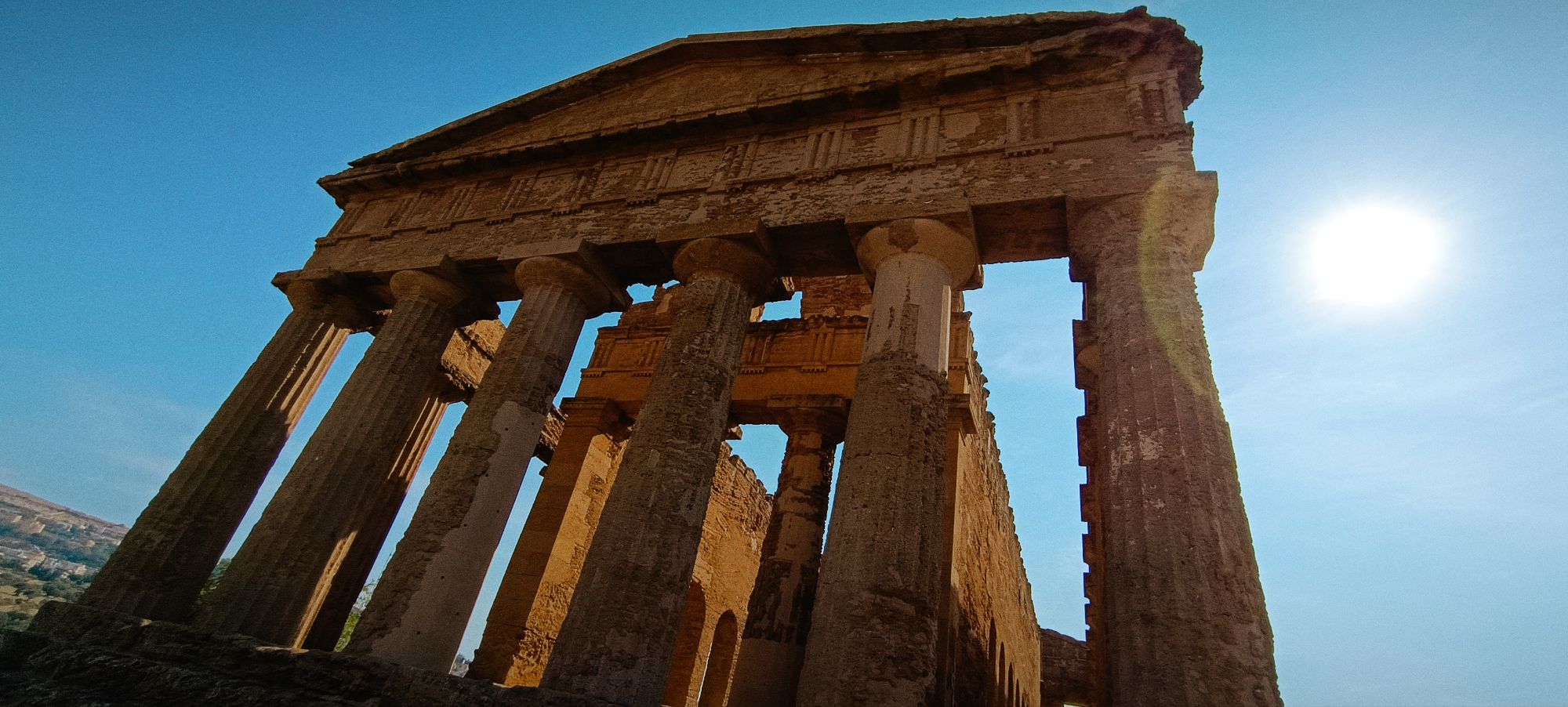
Slaves

More than 50,000 Carthaginian slaves

built the valley of the temples at Agrigento.

Treadmills and cranes moved the drums

of sandstone which were pegged together, and

the columns fluted and plastered. A coat

of paint, and the soft stone gleamed like marble.

The work of two dozen years, creating eternity.


Each temple held the cella of a god –

the classical embodiments of oh so many

precious human qualities. Imagine

worshippers outside, terror-annointed

in the burnished sun, wailing in ecstasy,

hungry for sacrifice – which they could buy

and eat at home. Oh, sacred takeaways.


And how awake were these Greeks, and Sicily

their chief disciple, their second home.

Great was their knowledge, their Mathematica.

Philosophers had logic to a T. Morality and sacrifice

their duty, and they loved a hemlock ending.

Dramatists posed the greatest questions,

and knew how to make ‘em laugh like kings.


And still those columns standing!

Still declaring for the everlasting things –

how genius rests upon the shoulders of slaves

whose judgments die unspoken in the dust.

And those invisibles, death-worked, fleshless,

likely beaten bones in pits, weep not for

them – for ages greatness grew from their labours.

Being one was the just reward for defeat,

as every Nazi knew. Our miracle that capital

investment, industrial production and the

despoiling of the planet should have put

to death the need for slaves. Progress indeed.

Blucher’s Football

The Hunting Lodge is Marshal Blucher’s,
at 74 a hero of the hour at Waterloo.
Bonaparte flees to a channel port. Arrested,
gains the ultimate security of St Helena.
His conquerors (to give the allied armies
the credit they are due) return to riches,
or impoverishment. It’s a classy business, war.

Blucher is feted. Titles, land, even honours
from a grateful British crown, are heaped.
He retreats to Poland, then another fiefdom
in a disunited land, and this minor palace
where he can pursue an older enemy: the boar.
But not for long. Death quickly follows – a mausoleum
is built, provides a final place rest upon his laurels.

History may pause, only to resume its ironies.
Earlier Napoleon had marched into the jaws of hell,
and smelt Its Russian breath. His first retreat,
the overture to his end. Peace stutters for a century
or more, before the devil, poked, at last comes back
to intervene in yet another war. Red army
soldiers break into the Marshall’s tomb and steal
his European bones. Anticipating sport’s
clashes are the way of things to come,
they use his skull for football as an interlude
upon the march to skewer peace once more.

And here we are. Poland’s free, and sovereign;
prosperity spreads down motorways that split
the darkening forests either side. Great bridges
span the carriageways to give the boar safe passage
beyond the reach of commerce, if not the hunter’s gun.

Old Blucher’s house adjusts itself to life as an hotel.
Outside, two dozen jeeps and four-by-fours
stand waiting, engines clattering, smoke
exhausting in the fresh dawn air, as in 45
T34s vibrated on their bloody tracks.
We are not a regiment of tankers, young
and eager, trembling for a red star flag –
we are assorted farmers, vets, adventurers
and mostly middle-aged or old. The trucks we’re
taking to Ukraine, and one more war
with Russian Armies beating on a distant drum.

Skibbereen

County Cork, 1845

It started here, the famine. A country and a people,
but with absent owners. Families housed in huts
of stone, with just enough to fill their ever-open mouths.
The potato comes – late growing, prolix, wholesome,
Peruvian. It makes their sons grow tall. It’s a solution
to a growing family’s needs. But comes from Mexico,
the Blight. The crops are ruined, hunger feeds
the staring eyes, rents are left unpaid.
The landlords, deaf to pity, shake their heads.

Then comes evictions; roofs and chimneys smashed;
an English Government that blames the victims
for their moral weakness, and believes the market
must be free to prosper her believers. Charities
endow soup kitchens, inventing unnutritious
broths; work schemes pay to break up rocks and
mend the roads for pennies; workhouses overflow.
Half-naked, ragged people crawl the streets,
their pitiful possessions in pawn, and die together
in the gutters. They’re buried coffinless in pits.

Good doctors wring their hands, sketches fill
the Illustrated London News, and, to its credit,
outrage fills the world – if not the hearts of Peel
and his be-whiskered friends. But tens of thousands
die, and Ireland’s emptied fields remain unfarmed.
Ships returning empty to America offer passage
in their holds – and those that do not die at sea
take with them betrayal of their land and hopes.

Today in Skibbereen, a tourist town, points map
where bodies fell; plaques mark the kitchen, gaunt
and empty as a jail. A new-age vegan bookshop
holds a range of old LPs, sells fairtrade coffee,
and a better kind of read; brightly painted bars
draw down the happiness of night; and shoe shops offer
style and comfort as you walk its streets of shame.

P

Of Cabbages and Kings

It’s an Irish morning. Rain stains the window
like frosted glass and wind moans in the locks.
Our horizon, a long dark smudge, overlooks
an estuary fed by two rivers. Where this abundance
meets in water, fresh and salt, Patrick
has his oyster beds. They flourish in this rare
accommodation in thin and lonely lines.
In Dicken’s London oysters fed the poor –
now they go to restaurants in Spain. But today
it’s Thursday – no time for mollusks in their shells.
Today the family feasts on cabbages and bacon.

On the stove the bacon’s boiled, the cabbage, sliced,
is cooked in liquor from the meat, and all is mixed,
then served with turnips, mashed. You may
imagine seasonings and butter, and laughter satisfied.

Out there the oysters wait their consummation.
Cleaned and tasting only of the sea,
they’ll pass down throats anonymous and cold.

Killorglin, on The Ring of Kerry