AFTER THE FUNERAL

Formalities over and farewells exchanged,

and a short ride through the town to the station –

May sunshine arouses the smell of departure

and carriages, warms the platform crowded with children.

They’re blazered and tied, and on their way home,

with voices sounding of suburbs and London –

confident in football and matches, their faces laughing,

and eager. Black children from freed generations,

and lost times of service on plantations,

and post war devotion to Queen and to promises.


The train comes and carries them homewards

and station on station deposits them places

where new lives have rooted, chains cast aside

in exchange for mortgages, ambitions, and gardens –

with Kent’s grammar schools nurturing for ages

of networks, home working, promotions.


Slowly the train refills as it cruises the rooftops,

the vanishing churches. More faces, more tongues,

more origin stories. Diasporas quicken and gather.

Down there, on the streets and bombed wastelands,

I grew up, not knowing of trade and decisions,

amongst white faces and chatter, excitement at bus stops.

We had maypoles in playgrounds, Home Service evenings,

a vanishing wartime, and comics and swappings.

Now those faces departed, and friendships forgotten.


And I’m back at the funeral, and Rachael.

A young woman, black and adopted, successful

and funny. Married and leaving her children, her husband,

my dear friends her parents. And taken, cremated.


And suddenly fading: outrage at the Empire,

the passage of slavers, the roots that discredit.

Today there is sunshine, and a city of hopefuls,

of unity, sadness, and still going forward.

Silence of the Lamb

The higher figure is St Stephen, early adopter

of the faith and stoned to death as martyr,

some say the first – with Paul of the epistles

joining in, when he was merely Jewish Saul.

Either way, a big day for them both.


Stephen’s face and hair is modern, a touch

Girls’ Own – not like the second, these eyes

stare from oriental lids, like semi precious stones.

He is Christ Pantocrator [yet another Word

Of God, and not another Christmas show,

though Christmas was indeed His first]. And that

is all we see of him. His mouth is covered

by Stephen’s hand, as if some secret was not

to be divulged, some miracle unuttered. To see

the sacred messenger held back is, to say the least,

unorthodox. A mystery of faith for any competent believer.


But scholarship repairs, explains all doubts, delivers.

Here we have two pictures from different times

and schools. Starts as a painted ikon for a church

which finds the figure of the saint its inspiration.

Some time later the martyr gets made-over with

a Christ, in some smokey workshop where they gild

the portrait till it shines with riches’ holy light.


For a century or so, the face beatifies a castle,

and the world is in its place. Then war and revolution burns,

its owner martyred by soldier atheists who also fire

rounds into the sacred face and toss the picture

in the mud to meet a trampled end, unfaithed.


But you cannot keep a good man down. Especially

Him. The picture’s taken up and hidden. For years

it dares not speak its name – then discovery appears.

It’s mud-engraved, and 3 bullets have left

stigmata on the staring Christ, but restoration

starts. With surgeon skills the holes are healed,

the stained and crusted background cleaned and rubbed away.

The revival soon reveals the older figure buried there

– the youthful face, the auburn hair – and as the hand

appears above the Mouth of God, the rest of Him

becomes a Cheshire cat , and rescue stops.

Should you remove the Son in favour of the Saint?

So an image of a silenced Christ remains, a sort of

collage to an age of doubt, to answer only for itself.


The picture hangs in Ostroh’s University – an ante-chapel

of a simple church – its history displayed. Its message,

layered by the days and times it’s seen, speaks out

the ironies of what may be believed and not, of conflicts

unresolved, of words that struggle to break free.

Slaves

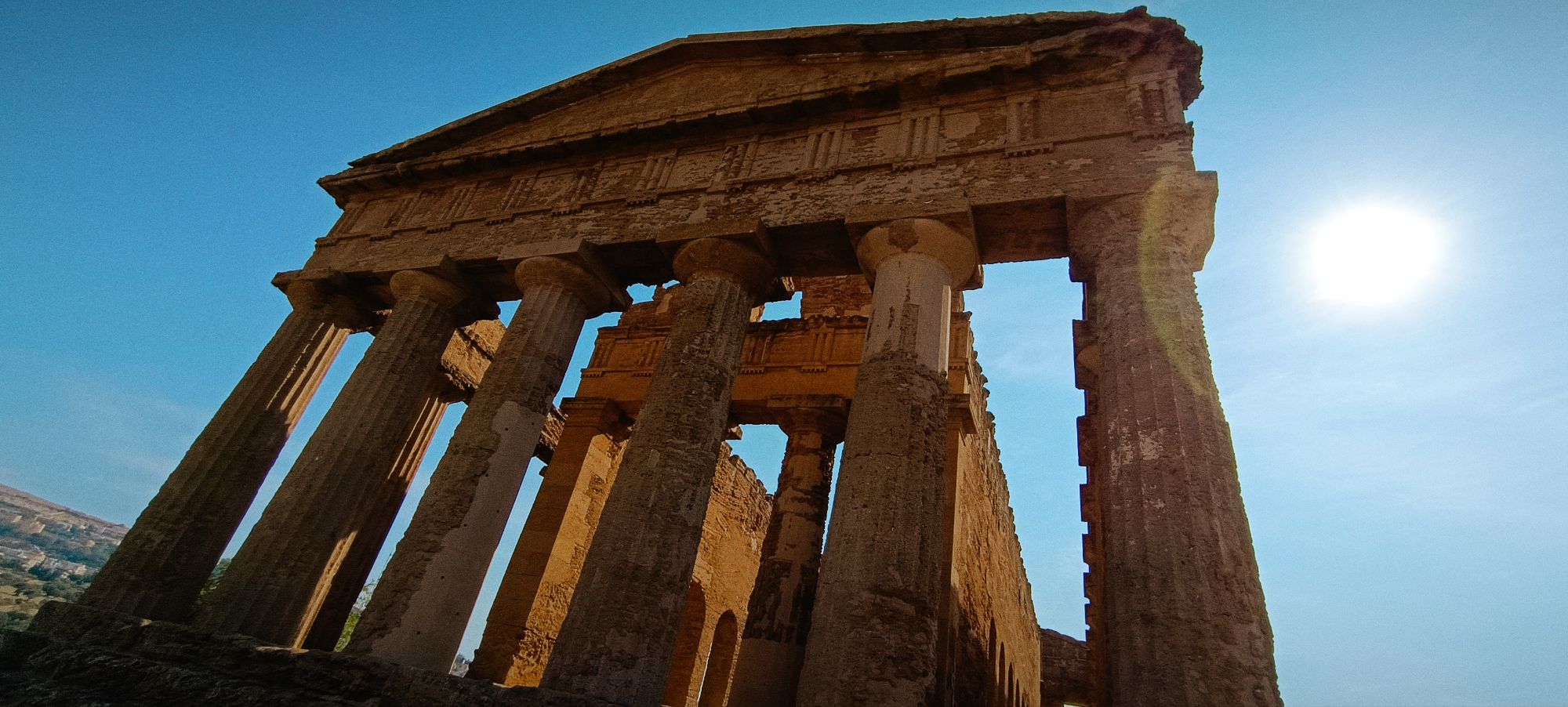
More than 50,000 Carthaginian slaves

built the valley of the temples at Agrigento.

Treadmills and cranes moved the drums

of sandstone which were pegged together, and

the columns fluted and plastered. A coat

of paint, and the soft stone gleamed like marble.

The work of two dozen years, creating eternity.


Each temple held the cella of a god –

the classical embodiments of oh so many

precious human qualities. Imagine

worshippers outside, terror-annointed

in the burnished sun, wailing in ecstasy,

hungry for sacrifice – which they could buy

and eat at home. Oh, sacred takeaways.


And how awake were these Greeks, and Sicily

their chief disciple, their second home.

Great was their knowledge, their Mathematica.

Philosophers had logic to a T. Morality and sacrifice

their duty, and they loved a hemlock ending.

Dramatists posed the greatest questions,

and knew how to make ‘em laugh like kings.


And still those columns standing!

Still declaring for the everlasting things –

how genius rests upon the shoulders of slaves

whose judgments die unspoken in the dust.

And those invisibles, death-worked, fleshless,

likely beaten bones in pits, weep not for

them – for ages greatness grew from their labours.

Being one was the just reward for defeat,

as every Nazi knew. Our miracle that capital

investment, industrial production and the

despoiling of the planet should have put

to death the need for slaves. Progress indeed.

Golden Domes

We reach the frontier and we have to wait,
lined up beside a mile long queue of wrecked and
battered cars, advancing to be scoured for spares.
Another offer to help a neighbour’s fight.

Processed and permitted, our group of time-warn
trucks is hurried under escort to Lviv. We speed
past golden domes and strips of land
hand tended by stooping men and women,
hoeing livings from their soil. Mingled strips of forest,
tillage, grazing horses, cows flicker past. More golden
domes. The roads are scarred with potholes –
unbottomed, unrepaired. Patched, welded, smokey
cars drive on, holding on to Soviet simplicity.

We cross red lights, and cock a snook
at trams which wait for us – in this land at war,
that’s caught in limbo between its would-be
conquerors, and our world of affluence and pensions,
of Payment Plans and Carbon-Friendly Schemes.

Workers’ flats, and jaded concrete workshops
guide us in, then at last the centre and its mediaeval wealth,
it’s untouched harmonies, its cobbled streets, its towers.

That night, ushered to our luxury hotel
by curfew we sleep the night away,
and do not hear the sirens heralding missiles
which fall beyond the city limits and our dreams.

Blucher’s Football

The Hunting Lodge is Marshal Blucher’s,
at 74 a hero of the hour at Waterloo.
Bonaparte flees to a channel port. Arrested,
gains the ultimate security of St Helena.
His conquerors (to give the allied armies
the credit they are due) return to riches,
or impoverishment. It’s a classy business, war.

Blucher is feted. Titles, land, even honours
from a grateful British crown, are heaped.
He retreats to Poland, then another fiefdom
in a disunited land, and this minor palace
where he can pursue an older enemy: the boar.
But not for long. Death quickly follows – a mausoleum
is built, provides a final place rest upon his laurels.

History may pause, only to resume its ironies.
Earlier Napoleon had marched into the jaws of hell,
and smelt Its Russian breath. His first retreat,
the overture to his end. Peace stutters for a century
or more, before the devil, poked, at last comes back
to intervene in yet another war. Red army
soldiers break into the Marshall’s tomb and steal
his European bones. Anticipating sport’s
clashes are the way of things to come,
they use his skull for football as an interlude
upon the march to skewer peace once more.

And here we are. Poland’s free, and sovereign;
prosperity spreads down motorways that split
the darkening forests either side. Great bridges
span the carriageways to give the boar safe passage
beyond the reach of commerce, if not the hunter’s gun.

Old Blucher’s house adjusts itself to life as an hotel.
Outside, two dozen jeeps and four-by-fours
stand waiting, engines clattering, smoke
exhausting in the fresh dawn air, as in 45
T34s vibrated on their bloody tracks.
We are not a regiment of tankers, young
and eager, trembling for a red star flag –
we are assorted farmers, vets, adventurers
and mostly middle-aged or old. The trucks we’re
taking to Ukraine, and one more war
with Russian Armies beating on a distant drum.