
The organist reads a paperback
As Elgar marches through the orchestra
Labelling his friends, giving them their subtleties:
Their inner calm, their petulance, their
Braggadocio at twilight. It’s about
Distances – the percussionist at his
Timpani, bruising the air – while violins cry
And bases purr like cats. It’s a workout
Of connections, of masks behind faces
Bringing everyone the edge of tears.
In this Hall, twelve thousand miles
From England, the imperial voice has cleared
Its throat. The paperback has disappeared
And deeper than a vault she sounds.
It’s Your Duty, Lad
The airside Smiths gives up a book of verse –
Poems of the First World War, and half
a dozen volumes labelled “Cats”.
They’re in a corner, hiding for their lives.
This side security – checked-in, case-free;
belts off and back; we stuff the junk
of travel safe in pockets, the threat of terror calmed.
No chance for stanzas, rhymes and iambs
to have dodged the scanner’s eye.
Or place for metaphysics or neologism
along the traipse and transport to the gate.
But halt! Ignore the final calls,
departure boards, the reasons to airborne
somewhere else. Don’t search for ironies
amongst the savage threat of duty free,
for assonance amongst pelucid stacks
of gin, for similes that tick from watches
big as moons. Go buy that book of poems
from the Somme, and just be thankful that
the shop’s computer chose it for the shelf.
27 Dollars
on
Tightrope
Selina Tusitala Marsh
Pasifika poetry warrior
Awake
in a city
a hotel
a book of black
black tiles mirroring
for minutes after reading
within
i am disturbed
thought
breaks up into
untraceable
I am blank
verse
but i have
no pen to write
back cover stretch the
images that try to
sell
the world
within
one phrase i cannot read
a sticker’s there
it is the price of verse
Lucifer, the Archangel
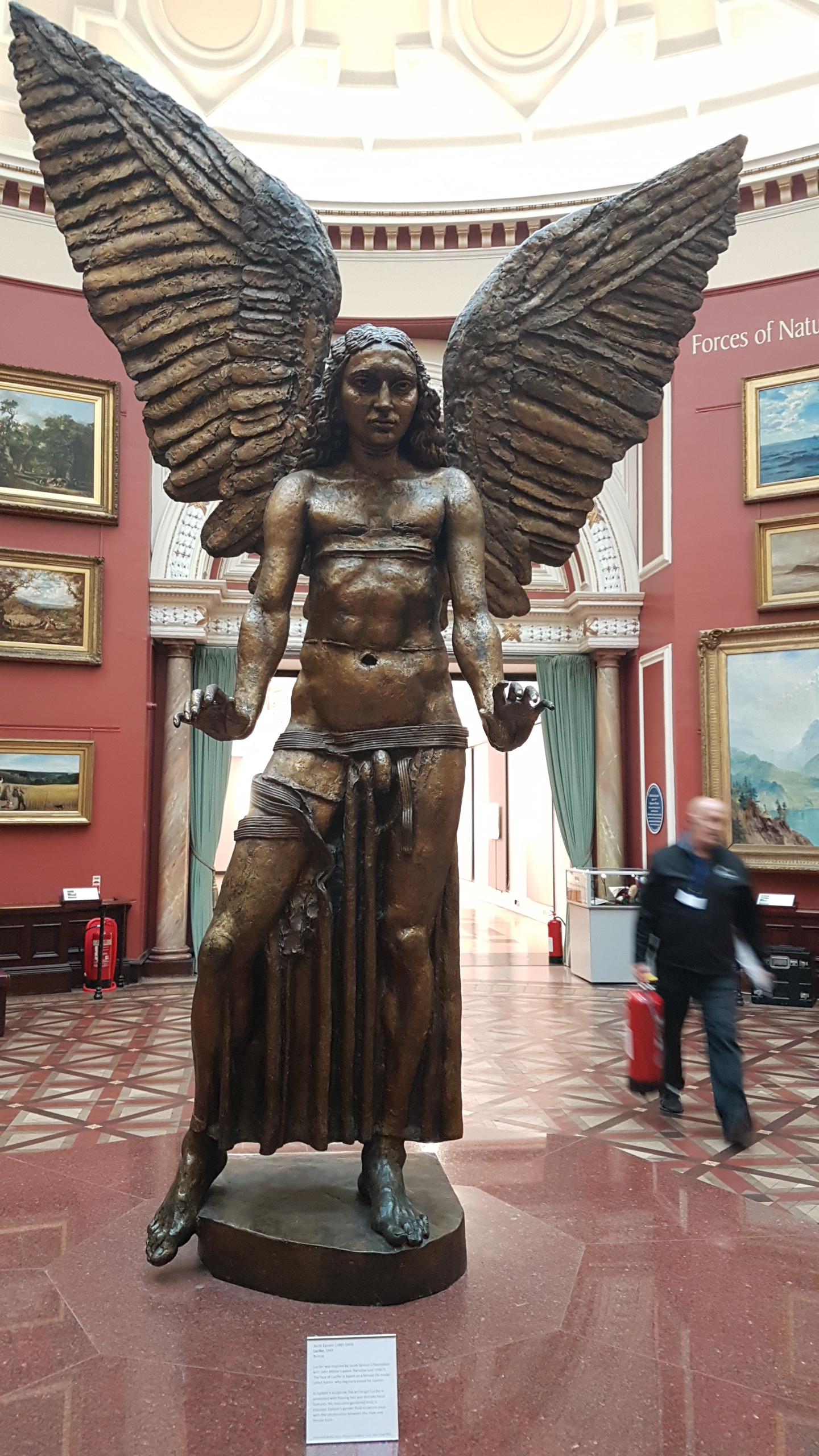
The Round Room. Almost overlooked Victorian
passions, pastimes, pastels – the stucco sentiment,
the pride of steam, the brotherhoods. In the centre,
Lucifer in bronze, Epstein’s metal fused
with difference – great wars have beaten out
the alloy, have taken up a mythic that is
brutish, new and sexual. A future, and a past.
The space is here for gathering, an entrance,
and a place to meet. This day, the first of many
schools have gathered beneath the startled wings.
The hands afraid to touch; the careful foot that takes
a step; the nakedness that knows no shame.
Eager girls are warned about their task, the need
to have a watch on time, the mobile phones
that may not see the light of art or day.
They’ve hours to spend with sketches, in their
badges, blazers, blue shirts, neat school ties.
A later party comes, they’re older – boys
with phones – girls who huddle, smirking.
Their teacher gathers them below the pinioned
gaze. Her German accent is refined and taut.
“You’re here to seek the stories of your past.”
She offers them a city gallery’s diaspora
of Cultures, Faiths and Races. They’re eager
for their liberty and swirl away. We talk – one teacher
to another. “My little ones would love the art in here –
but these just don’t care,” she says. Not having
any Group to organise, I’m on the side of hope.
Three lads are posing for their phones
with Lucifer, their temporary friend. “Don’t give up
on them. They’ve found a moment to engage!”
We laugh, exchange farewells, and disappear
in search of falling light, of favourites lost,
of pictures taken, slow becoming oaks.
Birmingham Museum & Art Gallery – January 2019
Firewatchers


Firewatchers in the Blitz, two men look down
on Bloomsbury and St Paul’s. Above their heads
drone Heinkels, in their schwarms. Above those,
darkness, thinning air, the silence of the gods.
I’ll put my father first. Warehouse clerk,
waiting out the aerial assault; in letters –
shocked beyond a word to tell his father,
brothers, what he saw. Then Eliot, poet,
editor, no head for heights, summoning his senses
for the faith of Four Quartets – the cunning, clever
labyrinth that puts injury and death aside,
and suffering; makes learning and allusion key
to meaning no cradling bomb can break.
They both survive – my dad to find a quiet war,
a wife, an only son. A decent life,
obscurity, and love. In sickness and in health.
For richer for poorer. An honest litany.
Eliot was making his – his reputation as modernist
and icon-maker, breaker of machines and idols,
fades. The ironist of Prufrock, the wasted cities,
now bejewells crown and custom of the Church;
as if his revolution had never circled overhead.
Unknowing of the other, both died 2 years apart.
I have a letter in my father’s hand that tears.
Only facsimiles of Eliot’s, and poetry, of course.
 J.A.Huddart