
It is about to be a moment Bruegel
could have painted. There are the builders
on the roof next door working, their hammers
reporting in the still air. From them to the edge
of the world a red square has opened. More tiles
are neatly stacked beneath them, waiting. A tractor
is going about its business reorganising nature.
An aeroplane is in the dreamy faraway
blue of the sky, And a man is falling.
For the record, he is working for the BBC.
He is filming a careful reconstruction
for a programme that lines up miraculous
survivals. It is his third jump of the day,
and his last. For the sake of Continuity
he has struggled into someone else’s
equipment as well as into someone else’s
moment not to die. He takes his two mile
walk on air. His helmet camera rolls.
The men on the roof look up. Across the air
his shouts are clear, “Oh no, Oh no, Oh no,”
They watch him loosening the tie of life to life,
and feel their own precariousness threaten.
He ends a mile away through trees in marshy
ground and leaves the world in silence. It takes
the searchers hours to dig his body out.
For days he’s falling through the village overhead.
Planes circle in our heads. He never seems
to land. An ending has us in its grasp.
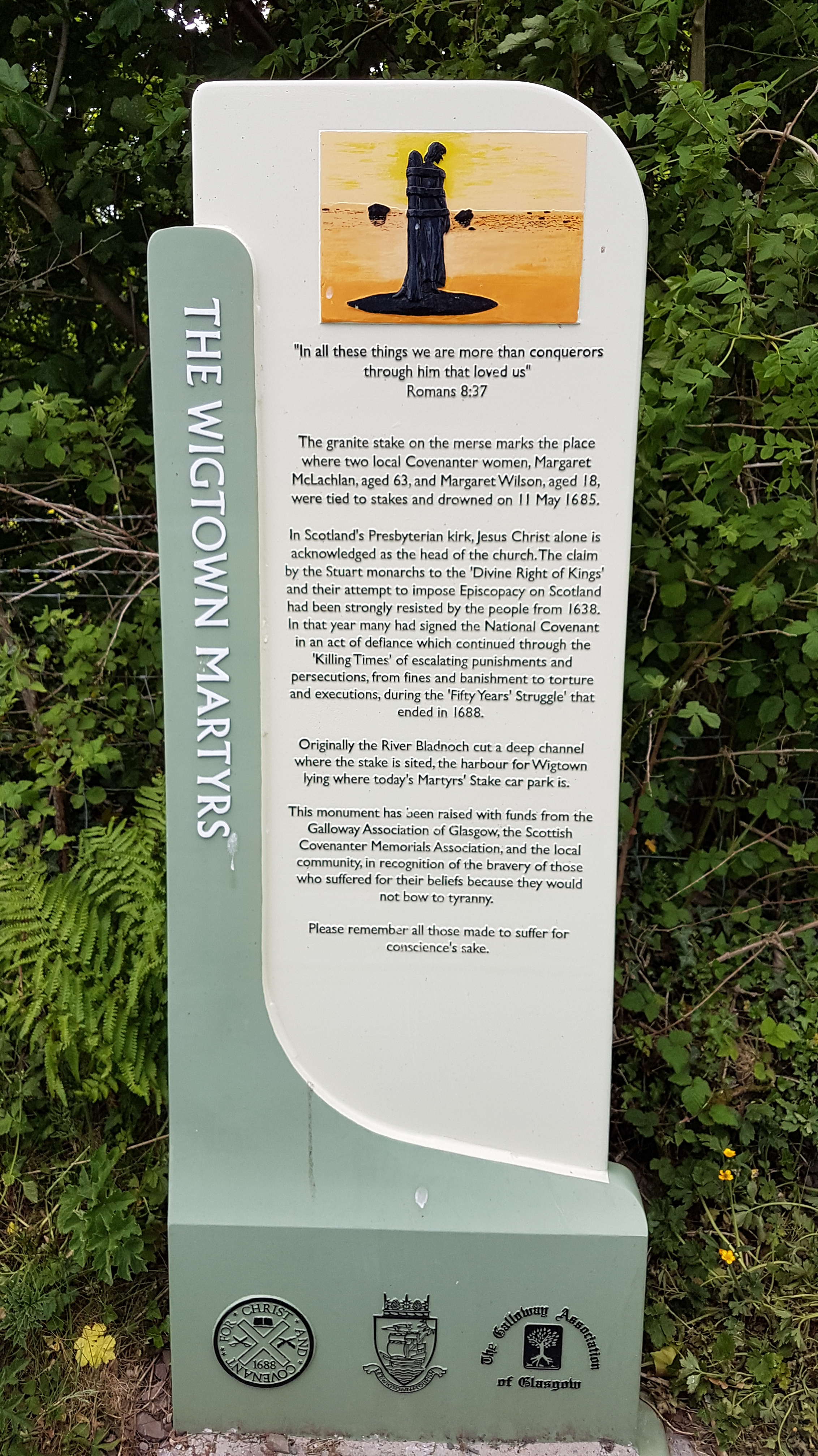
The Wigtown Women

In 1685, two women were executed
at Wigtown, Galloway, for being
Covenanters. Both called Margaret,
they were 19 and 65 years old.
They were tied to stakes in the
harbour and drowned by the tide.
4 men, convicted of the same
offence, were hanged.
God’s tide is coming, Margaret.
God’s tide is coming.
These stakes they have driven
Into the foul slime
Between their dry sinful lives
And the eternal sea
Are here to hold us to our faith.
Stout ropes that wrench
Our wrists, keep us to our covenant
With Him, as did his
Nails. Regard not their cries.
They shame themselves.
The sea will not wash their sin
Away when our lives
Go to Him. We die as upright
Christians, they to fester
In their beds of fever or sullen
Age. No quick rising
Waters will cleanse their filth.
The cold will cling
To us, will cleave to our heart’s
Core, but His Fire there
Will burn harder than hate’s laws.
We are but women –
Bodies meant for pain and giving
Life. Men, who spent
Their days in fields or hammering
Their praise, they hang
In air, strangled, broken necked
Like crows on a wall.
Poor things to be so separate
From life in death.
We they do not torment so.
Hand back our bodies
To the Lord. Think on this
Margaret. Do not despair.
One given body, one that’s
Yet to yield. That’s all
We are, and coming to His love.
Forget the cold around
Your breast. Drink deep.
Our names are there.
Whithorn
August 1995
Republished June 2018
The poem implies the elder woman gave the younger courage. In fact she was drowned first, so that her death might change the mind of the younger woman. Young Margaret did not yield, and the Episcopalian executioners allowed her to drown when she would not break her oath.
More than a Wordsworth
Above Dove Cottage, the coffin road dispatched the dead
to Ambleside and consecrated soil. Last journey of the flesh,
with rests upon the way for those who bore the box
and contents back. A time before. In Wordsworth’s day
The traffic had reversed. His body went the half a mile
to make it home. And now he’s with the others
in their private plots – a wealth of Wordsworths in a yard
of ground – father and son, daughter and wife.
A line of stones, chained off, and up against the wall.
His Town End house is now a shrine – a shop
and place of purchase on a past when words rang out
like gold or shining water in the hills. Now Names
display their praise in hopes paid homage brings
in leisured cash, and visitors whose memories of school
conceal those daffs, that cloud. Videos and books
uplift the heritage on sale. Quill pens predict
that writing still has possibilities in store.
Above, the fells. The silent graphite mines once worked
the smooth and slippery stuff that pencil makers
wrote their lifeblood in. Hard not to see the brightly
painted childhood tins, though makers and their families
are long since gone. And Wordsworth? Did he write
with pencil or the quill? Someone will know whose
livelihoods his slow and revolutionary hand supported.
His start was Cockermouth – At last I find a link.
A town that knew my father’s name knew his. Go down
the greats, and there you’ll see them play. The poet
child, and unknown ancestors of mine. Good men all.
Though dead, your words and blood were worth the
trouble that you took. I doubt that mine will live as long.
Grasmere 2006
Doctors’ Notes
A surgeon soldier, he surrenders with the rest
at Singapore. An empire, and an army, on its knees
before the bicycle army of Japan, neck stretched
and naked for the sword. In Changi, his baffled
tired men are told they are dishonoured
in defeat. Outside his prison, the kempetai chase
down for slaughter Chinese, Malays, whose tongue,
tattoos or faces pronounce them less than beasts.
A civil army, servants, refugees, they die
with no one there to see their fate. Their bodies
clog the beaches, and the nearby straits, and then
are gone. In gaol, white men whose European codes
and voices mark them down for cocktails in the club,
expect Genevan limits to their captivity.
But evident brutality becomes a fact, and they
are starved, and sicken, or are worked to death.
Confined in their infirmary, and using instruments
saved, made, or found, the doctors do their best
to mend or make men’s pitied bodies whole.
Each case or corpse is given care, and written up
to show the treatment needed to perform
the miracle again, or present the case for murder
at whatever end to war a peace might bring.
The suffering Japan might feel, is quick. No fever-feeble
dysenteric end for it. 2 bombs shake loose
their wrath, and all war’s children die. Demobbed
and suited back to home, he takes his papers and his box
of surgeon’s tools and keeps them till he dies.
Each futile case or life he’d rescued at its edge,
preserved as evidence for good, or cause enough
to gain a gallow’s pledge. The moment never comes.
He never has the chance to speak, and breaks
the grave promise he has kept those years. The notes
are thrown away. His children keep the case
of tools. And silence comes to make amends.
Each scalpel, saw, and knife their only cenotaph.
Ariel’s Magic
for Susan
Cut free from his forked pine by words –
see them sawing away at Sycorax’s wooden knots
through bark rougher than a mother’s tongue –
he [or in a show I once was in, a she] falls into a
different kind embrace, becomes its instrument –
a spelled out reading from another captured
heart, an island-limited old man in whose great books
are all the matter of his universe, his principality.
And in the air above a simple stage, set in a
castle ward, against its walls, the hate, the
vanished love of brothers for their other
selves, the grumbling venom of ambition,
lust and greed, the sleeping innocence of sex,
tumble out like swallows in the cooling blue-touched air
And far above, and all in ignorance of this
fine web of so much going on, a Boeing
rules a line across the space beyond,
takes west its own intriguers, courtiers,
lovers who have barely met, and men whose
words are destined to achieve their ends,
and then to vanish in the setting sun.

