Moon and Mustard

Blue Moon, I saw you standing alone,
Without a hope in your heart.
Without a love of your own.

A father singing. The train hushes the world.
His daughter, sitting on his knee, knows it’s for her.
She laughs, her apple face polished with happiness.
“Emma” she calls. Her word – holding child
and parent still while farms fidget past.

The mother, placed beside a son whose book
of puzzles, jokes and crosswords keeps him silently
himself, looks out at the ephemeralities. A blaze
of poster colour sweeps aside the green.
“Yellow” calls the little girl, exultantly,
and holds a hand to touch the glass that takes
this miracle along. “Mustard,” says her mother, and adds
another to the debt her daughter owes her in her heart.

No one thinks to tell her that it’s Rape. A bridge
goes past. The girl’s hand falls. The boy
fills in another word. The father sings Blue Moon.

British Rail, 1989

Giant Steps in Photography

[1]

Rockstar drunkard coping with easy gravity.
An unsteady child, his footprints litter the ground
like biscuits. First to this dustbowl beach he’s brought
his postcard flag, and wrinkled lilo suit.
The emptied eye of his face stares back,
collects the vacant space beyond. Shadows
stream from his feet holding us to his place
in history. Beyond the earthlit circle of his day
the cliches gather moonlight in the darkness.

[2]

The photograph my mother took of me in front
of my grey rusty Ford that cost her Seventy
Pounds cannot be found. The Instamatic
I bought her for her birthday would have taken it.
It too is lost. I stood beside the driver’s door,
the first of many times, and looked as if
another day would come. A smile or grin
would part fill the frame. The car would do
the rest. Her pride and love would not
have noticed any itchings to be gone.

[3]

Armstrong, Aldrin and the other one were up there
snapping at the very time. First steps
upon the moon, or miles in my first car.
Mankind will not forget. Exciting times
for human enterprise and care they were.

 Chester 1988

All History Now

for Andrew Pastor

Where other Councils would have placed a pier
or bandstand, Lyme keeps its town museum. Here
the past shelters from life’s unseasoned airs,
and graces, with its gothic roof and spires,
a shingle beach, The Cob, and boats that crowd
together in a harbour. Beyond, in closed-in cloud,
the careless tide picks fossils from each day
and turns them, with the humbler stuff, back to decay
and minerals and restless silt. Not so within:
a tweeded woman sitting with The Guardian
admits for 40p we unabrasive folk
whose harmless gaze alone will feast and pluck
at whorls and fragments of the protozoic slime
[and all the other local things that whim
and curiosity have rescued from the past
to fill the labelled cases under glass].

In spectacled insouciance, the lady
turns a page. So much gentility displayed. He
would be forgiven who thought these yesterdays
too crinolined to set a distant world ablaze.
We stroll past testaments to nearby craft
– The Cob [and tides] inlaid in wood; the deft
display of needlepoint; the church window
rescued from a field. “Like rummaging in a bureau
drawer” says Andrew who smiles and disappears.
A History man, he has an eye for what it wears.

I follow on, up towered stairs that tell
in photographs, of days cut off by fall
of snow, and find I’m looking at a small surprise:
the Focus of the Age had twice forgot its fears
of being too provincial, and had sent armies out.
Poor Monmouth was the first – Lyme has no doubt
his “character” lacked “firmness and nobility”.
He came ashore and was defeated. Posterity
allows his name to rule the beach his landing
fell on, if not a reputation standing.
Here are the slivers of his hanged men’s bones –
Judge Jeffreys did for them. He drank the town’s
hospitable wine and had his victim’s bellies split –
here’s the bill for board and booze, and next to it
the blackened disembowelling knife that showed
the innocent their shame and guilt. Three hundred
died, and under glass remain three artefacts.

From battle number two a heap of shot depicts
a bitter siege in 1644.
Not much to leave behind the English Civil War.
The size of gallstones these little things were brought
in having turned up on a tennis court
in 1938. How close and comforting
that sounds! No time of local gore or bloodletting –
unless you count the Great War Battleship
that sank, torpedoed. Downstairs, you mind, they keep
the boot that bailed and saved its owner’s lifeboat.
It looked like battered metal – almost too remote
to bring surviving death as close as words.
Well, maybe things speak louder than their deeds.

The lady with the paper calls us down.
“It’s lunchtime and we’re closing,” curls around
the narrow iron galleries. We go down stairs
as slowly as we dare. At the door she wears
a smile. “Do come back this afternoon.”
The noise of shouts and screams comes squalling in.
“That’s not the kind of person we like to see in Lyme,”
she says, and, sighing, locks the door on time.

October 1990

A Classical Education

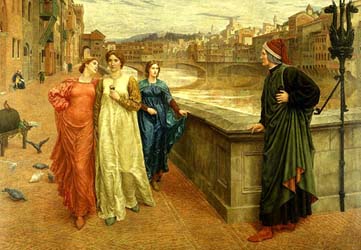
Dante and Beatrice [1883]
Henry Holiday [1839-1927]
Walker Art Gallery, Liverpool

The things men want.
There are
the held high breasts of
Beatrice’s companion as she
arches backwards
to look at him –
this strange man
in velvet green whose orange red tights
match the lining of his gown, his hat,
probably his thoughts,
and her.

But colour-blind Dante wants
none of that
very attainable-looking stuff.
The girl in red
has a foot shaped
like a snake’s head.
At the triangular junction
of her legs and belly
a ripple of cloth gathers
excitedly.

But, Dante, his face
enclosed forever in a Florentine sneer
that would sour wine,
ignores the obvious,
put there by the painter
for his obvious ease,
and stares
at the rose
held like him
where satiny cloth billows
empty
under Beatrice’s chin.

His left hand grips his ribs,
his gown, as if he has misplaced
his heart.
Beatrice decides wisely
to ignore this man.
Her shift clings to her legs
and her feet
are already dancing away.
Her body is for the birds,
and for horticulture.