Slaves

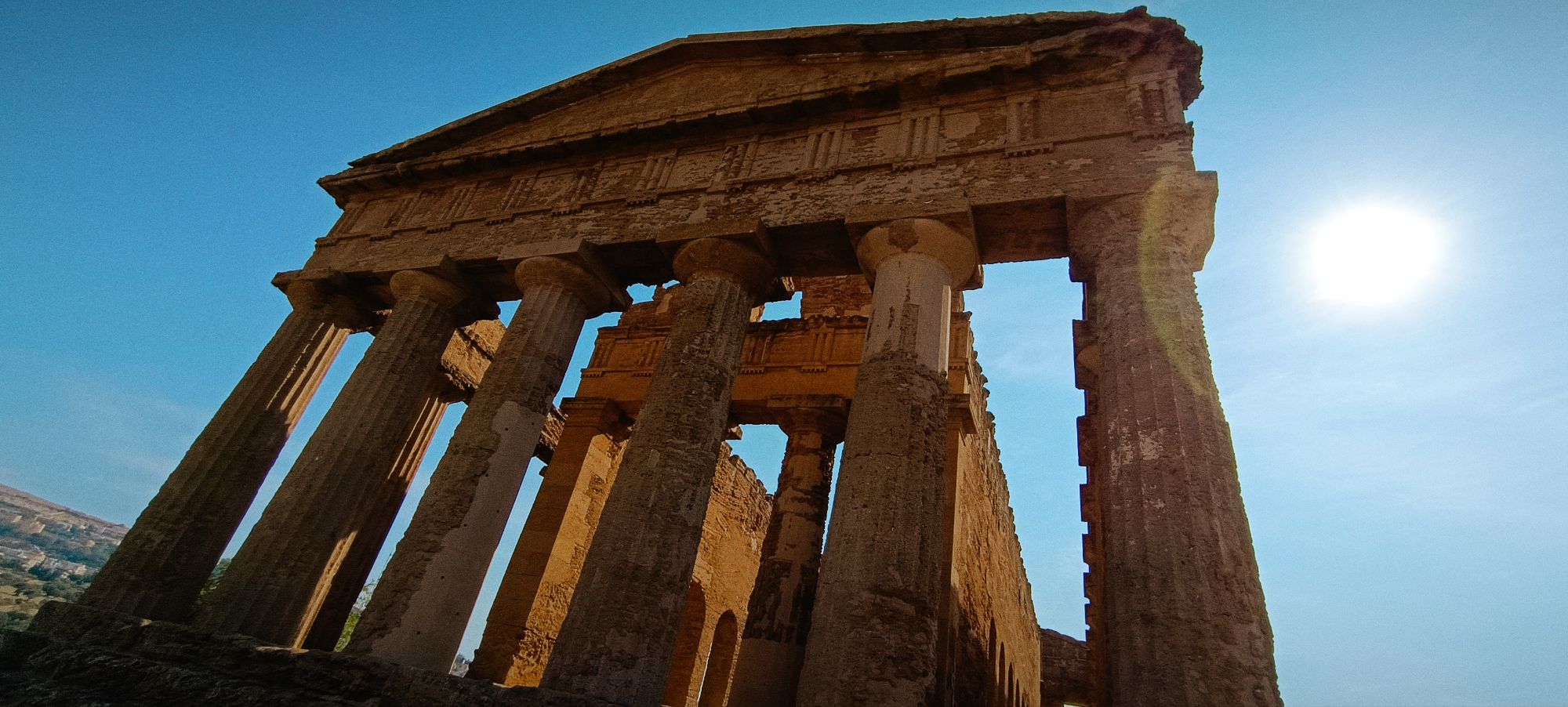
More than 50,000 Carthaginian slaves

built the valley of the temples at Agrigento.

Treadmills and cranes moved the drums

of sandstone which were pegged together, and

the columns fluted and plastered. A coat

of paint, and the soft stone gleamed like marble.

The work of two dozen years, creating eternity.


Each temple held the cella of a god –

the classical embodiments of oh so many

precious human qualities. Imagine

worshippers outside, terror-annointed

in the burnished sun, wailing in ecstasy,

hungry for sacrifice – which they could buy

and eat at home. Oh, sacred takeaways.


And how awake were these Greeks, and Sicily

their chief disciple, their second home.

Great was their knowledge, their Mathematica.

Philosophers had logic to a T. Morality and sacrifice

their duty, and they loved a hemlock ending.

Dramatists posed the greatest questions,

and knew how to make ‘em laugh like kings.


And still those columns standing!

Still declaring for the everlasting things –

how genius rests upon the shoulders of slaves

whose judgments die unspoken in the dust.

And those invisibles, death-worked, fleshless,

likely beaten bones in pits, weep not for

them – for ages greatness grew from their labours.

Being one was the just reward for defeat,

as every Nazi knew. Our miracle that capital

investment, industrial production and the

despoiling of the planet should have put

to death the need for slaves. Progress indeed.

Minions

In the blue-dark reaches of the hall a salvaged temple
glowers. Its perfection was at once implacable, unique.
I tilt the camera to upset its verticality. Cracks
upon the battered marble  betray as many failures
as the years. It’s Euclidian authority persists, though gods
are gone. Between its columns [ionic, fluted,
fractured] – cemented following  some Samsonite
assault – three females, headless, bustle. On every
blank and stone a busy frieze preserves a land
of riders spurred to war, or hustling shoulders
under flowing robes. Such noble haunches,
muscled thighs. Horses galloping a Muybridge
rotoscope. The pageant pediment meets
eyeless night – a held up universe upheld.

A disconnect occurs. Atomic structures move apart.
The living die, drift, disinter themselves.
Spaces empty; causes, contexts seek
their makers and are gone. Warmed and holy
streets give up their savage gods, become
a grid for sneakers, flip-flops, country casuals
and cool co-ordinates. Guide books flourish,
bring light through panes that face the sun.
The past unfolds – and, newly peopled, moves
in through blankened days and distances. Disturbs.

I raise my phone again and hide behind its camera
screen. A man in jeans and blue t shirt, cartoon
Minions printed across his belly’s comfortable
expanse holds centre of the frame. He looks
aside, holds knees apart. He’s bored
but in control. His back is turned, unseeing.

Bring down your gods, your headless dancers;
repopulate the scene with dreamers who can walk
the shadows of a thousand thousand days.

The Nereid Monument


Gallery 18, The British Museum

A milk marble hall, glacier cool,
light-diffused, shadowless, contains
the sum of everything we are.
A dozen histories, too many lives to count.

More than a gallery – a debate between nations,
bound in division. More than a simple tale:
the Imperial power rescuing the past;
snatching perfection from the ruins; good job

done & blah de blah. But that’s not the half!
The Parthenon presents a pantheist facade –
with Greeks and Christians out, the Koran replaced
our babble of the west – with its Socratean

sacrifice, then handy three Gods in One.
At first, a redoubt of the Prophet, then a powder
house – if Seven Pillars are not explosive power
enough, the stage is set for blind destruction –

by Venetians. A mortar round creates,
the ruins that will stand for years.
Then Elgin starts his mission to preserve.
Copies he seeks at first, until removal

seems his better choice – his throw of marbles
that will attach his name to antiquity forever.
A dubious grant of passage by the Turks
appears, and back from the Sultan’s Ottoman

Bazaar, they come. At first the good lord thinks
they’d decorate his modest Scottish home,
but flogs them to satisfy a hunger for divorce.
By now the English cultural crowd is well alight.

Byron rails, and anger thunders
through the land. A game of sides:
Not good enough! some said – That vandal!
others cried – but come they did, to London

for give or take a modest 30,000 pounds.
So here we are: a good selection,
[by no means all] of chiseled skill and pride,
Now clear of paint that would have

wowed the Acropolitan elite.
As we now stand, and point our phones,
they too would look in awe, as feet above
their heads, they grasped the chase of war,

the languor of those robes, the genius of Phidias.
And how these strolling sages and philosophers
loved their centaurs and their acts of rape –
part maths, part myths, their minds

Emerging into mirrors and to smoke.
At home in Athens, remains the other half –
holed up in a gallery of its own,
while the battered Parthenon itself endures

in time – through use as treasury, and church,
as mosque and magazine – to stand for ruined
glory and the pulverized democracy the ancients
in their wisdom talked about and lost.

The Parthenon, The British Museum
July 2017