
Ben, his voice emerging from his beatbox belt,
assures his comet tail of visitors that opulent
extravagance will always give simple piety
a run for its money. New age apostle, he’s
Speaking of the baroque, a style that clothes his city. –
Valetta, much photographed, much toured,
much bombed. Its spine, Republic Street [commemorates
Independence from us Brits] runs arrow straight
down to Saint Elmo’s Fort, now a war shrine
to survival. We cross it several times – past palaces,
churches, bars, museums, high windows where
still the ravages of war are yet to be repaired.
I leave Ben at the Co-cathedral of Saint John.
Who can fail to marvel at the transformation
Stone displays when every inch has been the subject
of a golden alchemy? It is religion’s trinket box.
And who cannot wonder at the wealth and power
of those who chose to stop our doubting mouths
with gold. They also have another asset – Caravaggio,
who comes here to escape Roman justice
as a murderer – and faces death himself.
The Knights of Malta do not miss a trick.
He’s promoted, then protected by his rank.
They give him a wall of their cathedral to fill,
and the sentence of their martyred saint as theme.
Caravaggio invents a line of beauty sharp
with miracles, his oils flame in the darkness,
are sunlight following – it’s invisible presence
placed with unerring stagecraft to discover
humanity clothed in its bloody everyday.
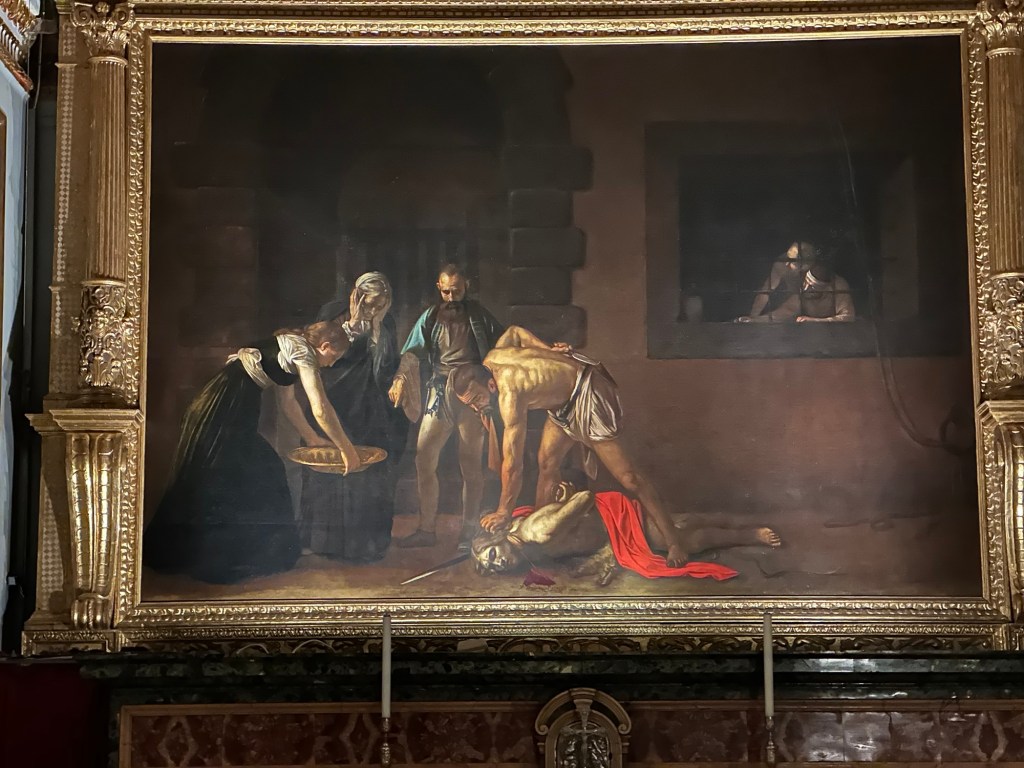
There is the Baptist, whose pale and nearly
severed head now cannot see the point at all.
Behind, the muscled, semi-naked executioner
gleams like a freshly risen Christ. One hand
grasps hair, the other holds a butcher’s knife
concealed behind his back. And there’s Salome,
ordinary girl in a peasant skirt, and cause of all,
whose petulant revenge holds out a salver
for the hacked-off head. Then the witnesses –
the determined jailer, bearded, stern, points a
finger of command; a woman old and shocked,
maybe the baptist’s mother summoned for
the punishment of grief; and two prisoners
seeing their own inevitable end. Tiny at the bottom,
only just untainted by the blood, the signature,
the only one he left in paint, of Michelangelo
de Caravaggio, He too destined for an early death,
not from an executioner but from disease or drains.
Brilliant and engaging, but remember, beyond
the expected sudden shock of drama, the epic
reimagined story, and the meretricious opulence
of the church which frames all this, there is the feel
of pointlessness. A greatness that has outlived,
is just the price of leaf, the value of the auction house.
Somewhere on Ben’s two-hour tour, he will have
reached the bar where Oliver Reed performed
his final moments, his body washed and cleansed
with lager, scotch and emptied thought. I try to
picture this death scene as Caravaggio might
have rendered it – The sunlight playing on
vacated glasses; the eyes just losing
sight and focus; the other drinkers open-
mouthed but ready to remember the roles they
played. This place another shrine where
legends grow to miracles, to capture laughing.


Storytelling, history teaching and art appreciation at their very best. I shall forever associate John the Baptist with Oliver Reed!
Davidxx
LikeLike