Money on the Beach

Speed brings us to our goal, time-defying
outboards slashing swell and tide to take us
round the islands, to the saddest, best of all.
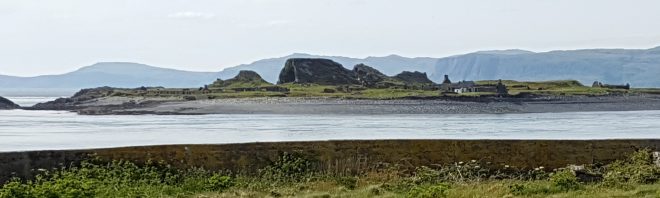
Belnahua, Mouth of the Cave, and population nil.

Between the Gaelic and this desolation, hundreds –
blasting, cutting, slivering the deep grey rock
to slates of purest quality for cities and cathedrals,
castles, homes. The Great War took away the men.
And that was that – the quarries closed, emptiness
moved in to fill the homes, the deep-cut pools.

We step onto its rocks, which rise up from dark seas,
its jetty having perished in some storm, and seize our
phones for what will be a rich reward of shots and
careful views. And so it proves. The pictures almost
say it all – but, thanks to an emerging sun and lunch
in view, avoid the ghosts, the sense of something
having come and gone. We walk upon the beach,
the grey sand holds our steps as ransom
to a faithless one’s return. Everywhere the sea
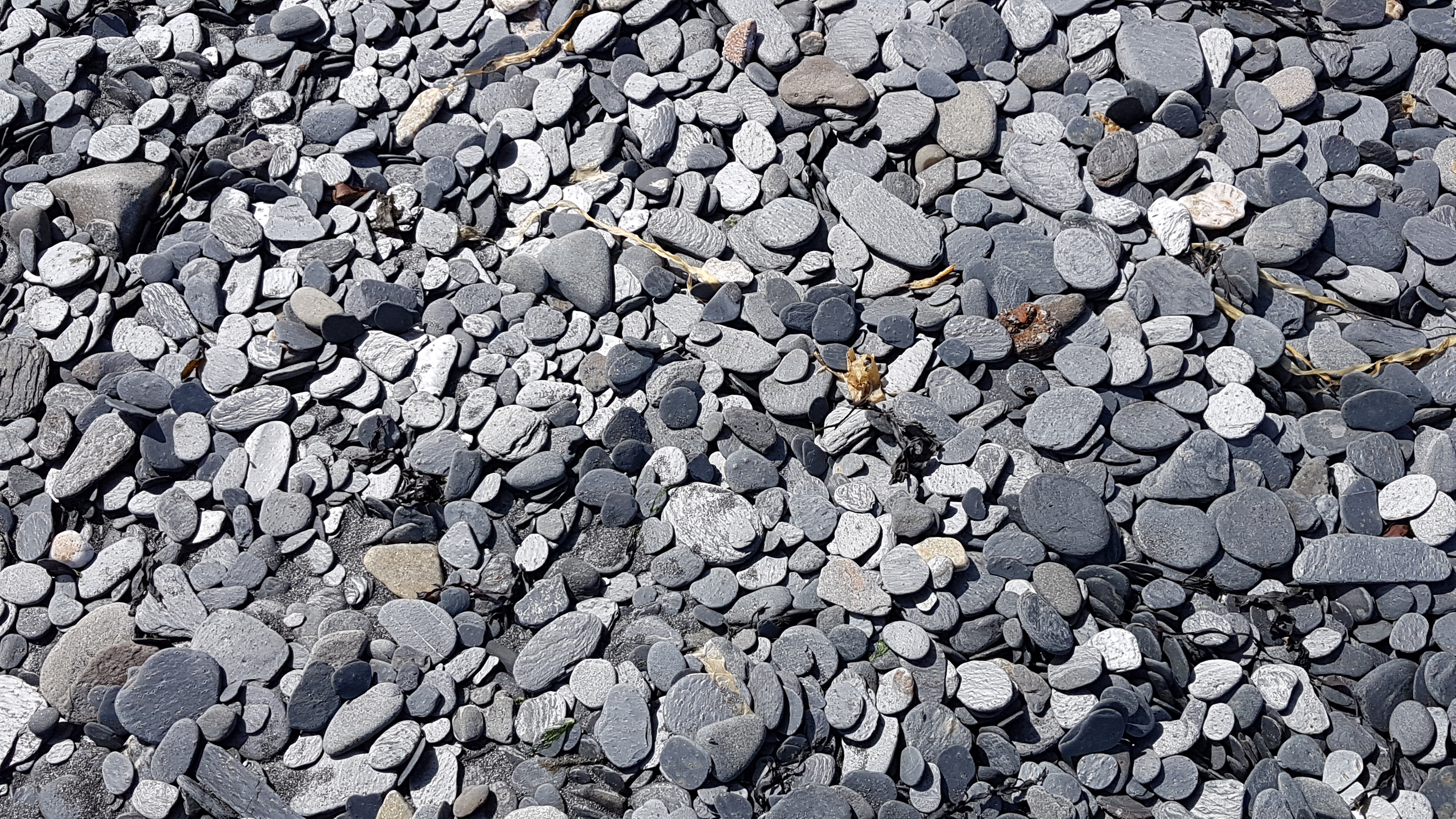
has forced its love upon the land lie discs
of slate like giant coins – that mime the wealth
that went across the sound; that still remains.

Seeing how the water’s work has shaped them
so exact, our host returns to take some hundreds home
for table markers at her daughter’s wedding feast.
Pictish Gaels could make them platters just the same.

These hundred years have taken many things.
For isle of slate, no trace remains of any roof
that kept the families safe beneath, the tiny
grates now only view the open skies.
Today the sun has made a diamond basket
of the sea. On winter days, when rain drove in
across a cauldron of cold spite, those smokey
hearths would struggle to keep heart in homes
and lives, or dry the peoples’ sodden clothes.

For us, bright spring charms everything; wild
flowers sprinkle galaxies of colour through the grass;
a spray of pink that grows at what was once a door
presents a wreath that marks a silence, and a lack.
Birds cry at our intrusion on their family lives.

Of those machines that hauled and raised the slate,
just artwork groups remain – the cogs like fists,
the wheels that do not turn, the rods and bars
that don’t connect. Upright, standing guard
and mute about their tasks or owners, and what the scrapmen
took away, to leave them poignant and unsolved.

So one more scene of work and power that’s gone.
Our lawyers, bankers and insurance men are kings,
they drive the engines of our wealth along
and often own these sites for play, or their portfolios.

The Slate Isles, edged on Scotland’s ocean rim,
once Roofed the World, are one more tale of past
success that leads to failure in the end. As if a pride
in what was once must always be the final aim –
with ruins, records, graves, looked over
and picked bare by community researchers, their children
gone away, or left to dissolution, careless, and unclaimed.
Belnahua 2017
See Belnahua Gallery



Coalbrookdale

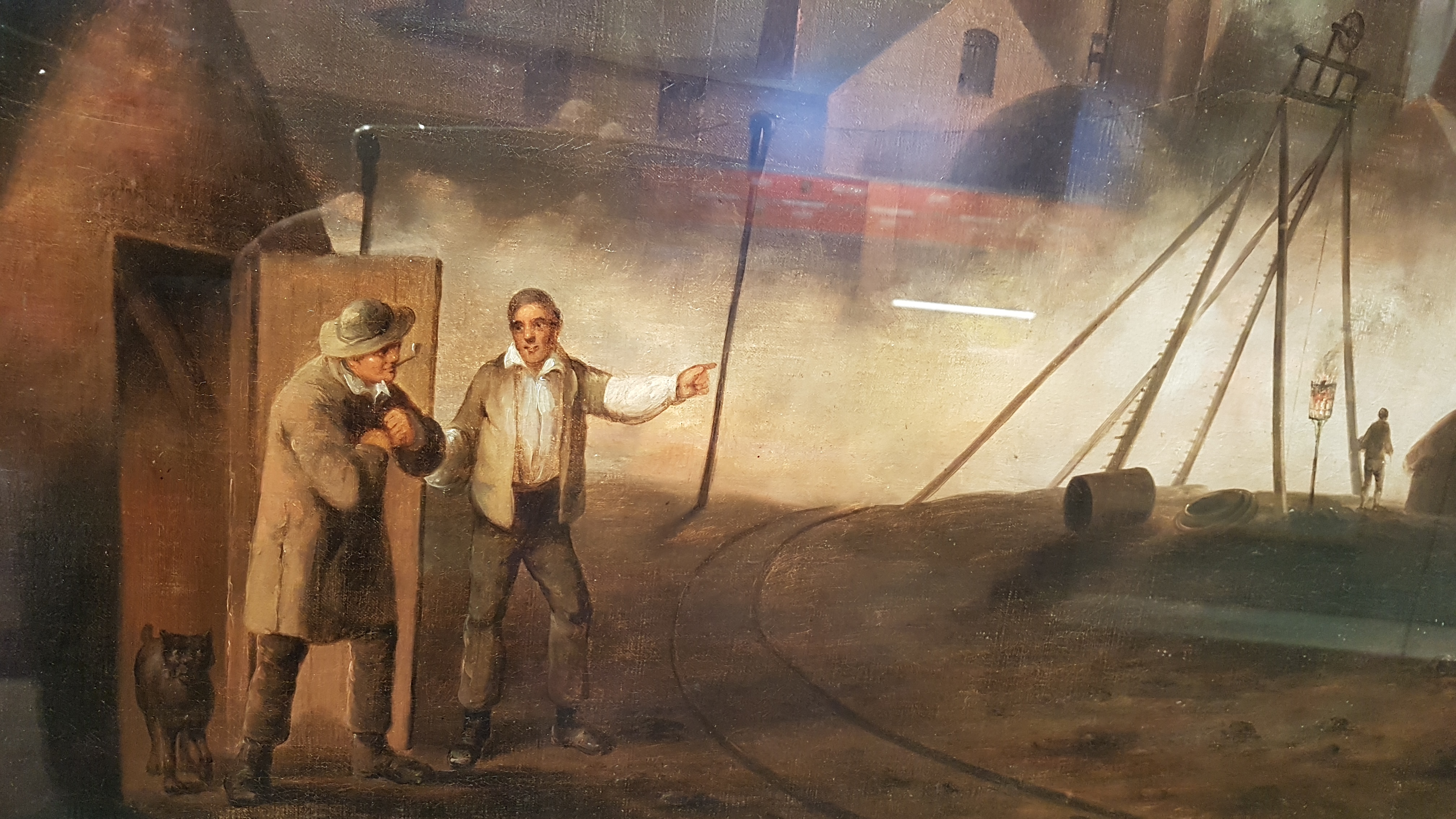
Abraham Darby went through several iterations
before his name allowed itself the pleasure of some fame.
A self-effacing Quaker, each regeneration brought the
ironmaster’s brand a step towards its immortality,
and now it’s cast into the very metal of his trade,
the mighty coping of his furnaces, the base
of pots, the soaring spans of trademark bridges.

A pioneer, he took the sulphurous coal the other
smelters left as too impure and breathed God’s fire
into the glowing ore till hell’s hoofprint burnt away.
It was a lesson others took to heart, and blessed with
roads, canals and space, took to the rise of wealth
and profit like lords of everything unclaimed.

So runs the parable of our times, the rags to riches
of a wit and wisdom bi-ped ape, who takes the offered
tool and beats a mighty share with it; who makes
the hammer into wand, and shapes the earth into a
kingdom for the poor to glimpse, the clever to exploit,
the owners of account to play like gods. This vision
so far never fails.   With tweaks and nods to justice,
rights of man, some post-modern stuff about
our equals, science and persistent fear of pain
and death, we’re still aboard that occident express.

So celebrate the prophet of the age, whichever Abraham
it was, who smote the ore from rock, who split
the coal from hidden seams, who tamed the crucible
of fire. Remember how he led his flocks through woodland
paths on Sundays with the Lord, and weekdays brought
the boats through rushing waters of the mighty Severn
to ship his pots and castings to the World. And if it sounds
as if a Spielberg or De Mille was standing ready, with crew
and talent in the wings, that’s how it was, that day of days.

Today, the workshop’s closed, the streams of iron
cooled, the men and women passed away. Key names
remain on show: the warehouse is a many levelled hall,
its curiosities accessed by comfortable lift. Hemmed in
by hills and rendered picturesque by bosky vales,
no room to make the massive steels and girders
that went to span whole continents with steam.
All greatness turns upon itself, as coke to ash.

Coalbrookdale November 2017

As ill luck would have it, the Mighty Aga Factory that still used iron cast in Coalbrookdale, was closed two weeks after we visited, on the very day I finished writing this. 35 ironmasters lost their jobs as cheaper metal had been found elsewhere. An American company had bought the global brand, and did what business has to do – moved on to better bottom lines. 

Passchendaele

31st July 1917

If Europe was at war again
could it ever match the stain
of Passchendaele? The last throw,
the final act to put the sense of war
beyond all doubt. This word,
a mere location on a local map,
eyed with monocular vision by
the wisdom of the general staff,
is now an onomatopoeic standfast
for our times, so easily does it slip
into our tongue, with its Flemish
orthography hiding English suffering
and death. Lest we forget, as many
German dead are counted, but
the battle over numbers never ends,
though together, all no more.

But could we be at war again
when so many days as these
and broken lives and empty
hearts, have made their argument?
If suffering disaster binds, then
selfish statehood surely puts us back
to where we were, when treaties
only bound our continent to making war.

Starting today, 100 years ago
when much of Europe burns in heat
and ending in November when cold
will hold its heart, how right it is
to remember these unnumbered dead.
When those who take us out
of union assert the cause of unity
and peace are not the same; that nations
are better off alone to fight their battles
once again, and seek for allies in
the empire that’s gone.

Ischia
31st July 2017

Minions

In the blue-dark reaches of the hall a salvaged temple
glowers. Its perfection was at once implacable, unique.
I tilt the camera to upset its verticality. Cracks
upon the battered marble  betray as many failures
as the years. It’s Euclidian authority persists, though gods
are gone. Between its columns [ionic, fluted,
fractured] – cemented following  some Samsonite
assault – three females, headless, bustle. On every
blank and stone a busy frieze preserves a land
of riders spurred to war, or hustling shoulders
under flowing robes. Such noble haunches,
muscled thighs. Horses galloping a Muybridge
rotoscope. The pageant pediment meets
eyeless night – a held up universe upheld.

A disconnect occurs. Atomic structures move apart.
The living die, drift, disinter themselves.
Spaces empty; causes, contexts seek
their makers and are gone. Warmed and holy
streets give up their savage gods, become
a grid for sneakers, flip-flops, country casuals
and cool co-ordinates. Guide books flourish,
bring light through panes that face the sun.
The past unfolds – and, newly peopled, moves
in through blankened days and distances. Disturbs.

I raise my phone again and hide behind its camera
screen. A man in jeans and blue t shirt, cartoon
Minions printed across his belly’s comfortable
expanse holds centre of the frame. He looks
aside, holds knees apart. He’s bored
but in control. His back is turned, unseeing.

Bring down your gods, your headless dancers;
repopulate the scene with dreamers who can walk
the shadows of a thousand thousand days.

The Nereid Monument


Gallery 18, The British Museum

A milk marble hall, glacier cool,
light-diffused, shadowless, contains
the sum of everything we are.
A dozen histories, too many lives to count.

More than a gallery – a debate between nations,
bound in division. More than a simple tale:
the Imperial power rescuing the past;
snatching perfection from the ruins; good job

done & blah de blah. But that’s not the half!
The Parthenon presents a pantheist facade –
with Greeks and Christians out, the Koran replaced
our babble of the west – with its Socratean

sacrifice, then handy three Gods in One.
At first, a redoubt of the Prophet, then a powder
house – if Seven Pillars are not explosive power
enough, the stage is set for blind destruction –

by Venetians. A mortar round creates,
the ruins that will stand for years.
Then Elgin starts his mission to preserve.
Copies he seeks at first, until removal

seems his better choice – his throw of marbles
that will attach his name to antiquity forever.
A dubious grant of passage by the Turks
appears, and back from the Sultan’s Ottoman

Bazaar, they come. At first the good lord thinks
they’d decorate his modest Scottish home,
but flogs them to satisfy a hunger for divorce.
By now the English cultural crowd is well alight.

Byron rails, and anger thunders
through the land. A game of sides:
Not good enough! some said – That vandal!
others cried – but come they did, to London

for give or take a modest 30,000 pounds.
So here we are: a good selection,
[by no means all] of chiseled skill and pride,
Now clear of paint that would have

wowed the Acropolitan elite.
As we now stand, and point our phones,
they too would look in awe, as feet above
their heads, they grasped the chase of war,

the languor of those robes, the genius of Phidias.
And how these strolling sages and philosophers
loved their centaurs and their acts of rape –
part maths, part myths, their minds

Emerging into mirrors and to smoke.
At home in Athens, remains the other half –
holed up in a gallery of its own,
while the battered Parthenon itself endures

in time – through use as treasury, and church,
as mosque and magazine – to stand for ruined
glory and the pulverized democracy the ancients
in their wisdom talked about and lost.

The Parthenon, The British Museum
July 2017